
As we enter a new era of strategic planning – manifested through the preparation of a wave of Spatial Development Strategies (SDS) covering the country – could we also be about to embark on a significant shift in approach to plan-making and the evidence that has traditionally underpinned it?
These new strategies are a crucial part of the government’s mission to align strategic planning with devolution geographies. Strategic Planning Authorities (SPAs) across England will have responsibility for preparing them, and whilst the government has set out a clear ambition for universal coverage of SDS by the end of 2029, we are still some way off universal agreement about what these SDS geographies will actually look like [1].
From ‘evidence-based’ to ‘vision-led’: a welcome opportunity for transformative change
Proposed changes to the National Planning Policy Framework (NPPF), published in December 2025, start to provide some clarity on what SDS should and shouldn’t include, with an overarching emphasis on setting “a positive vision for future growth and change at a sub-regional scale” [2].
In particular, they are expected to be ‘vision-led’, providing a long-term spatial framework for investment, development and growth – supported by sufficiently robust and up-to-date evidence, but not necessarily constrained by. This signals a subtle but important shift away from evidence based to evidence supported (as discussed in this insightful blog post by Catriona Riddell). But what does this mean in practical terms, and for SPAs tasked with getting their SDS underway as soon as possible?
This shift presumably applies to all disciplines, but for socio-economics is very welcome. In terms of planning for employment land in particular, an opportunity to move away from traditional ‘predict and provide’ approaches that in many cases can fail to fully reflect the scope and potential for economic change and diversification in an area (as explored further in my colleague Alex O’Byrne’s recent blog). Particularly in absence of strong local political leadership and ambition for change.
It also coincides with recent (February 2026) updates to HM Treasury’s Green Book guidance on appraising and evaluating public spending, now with greater emphasis on place-based analysis and capturing transformational impacts and change.
We have already seen this evolution take place in other sectors such as transport planning where recent changes to the NPPF have introduced a fresh approach known as ‘vision and validate’; instead of relying solely on forecasts based on past data, this method requires decision makers to articulate a clear vision for the future (such as modal shift, active travel, reduced car dependency etc.) and then actively test, monitor, and adjust their forecasts as conditions evolve.
As we await further guidance from government (including national templates for core SDS technical evidence), we have been thinking about what this shift – towards a less prescriptive, more vision-led approach – could mean for preparing SDS socio-economic evidence:
- Vision-led – start with the outcomes you want to achieve for a place (economic resilience, inclusive growth, clean growth etc.) rather than relying on baseline data and economic trends to guide the future. The key question will then be, how can we use evidence to ‘support’ this ambition rather than drive it? This might take the lead from an area’s Local Growth Plan (if it has one – see below), draw on recent investment into local economic infrastructure (such as skills, energy facilities, transport etc.) or look to take advantage of an area’s unique (but as yet untapped) environmental, heritage, or community assets.
- Monitor and manage – actively build review periods into the SDS so that if employment land take-up, population growth or sector performance doesn’t follow expectations, the strategy can adapt, rather than being anchored to a single evidence base, developed at the outset, but that ages immediately. SDS must cover a period of at least 20 years so will be particularly sensitive to short-term changes in performance and priorities, and to critical underlying assumptions (e.g. scale, nature, location of growth). A proactive monitor and manage framework combines continuous data collection, performance monitoring, and flexible interventions. It could be based on fairly real time data (using sources such as CoStar and Realyse) that triggers a review, and if necessary, a change in direction.
- Proportionate – the government is clear that SDS evidence is not just Local Plan evidence at a bigger scale. For socio-economics, this means strategic-level insight about economic priorities and infrastructure needs (and how this translates into spatial growth priorities/locations) rather than granular site-level assessments and recommendations.
- Partnership – whilst stakeholder engagement has always been an important part of evidence base production, this becomes even more critical when developing a spatial growth strategy that spans multiple Local Planning Authority areas with varying economic priorities and political ambitions. This is likely to require more effective, more meaningful engagement at the outset to ensure some degree of consistency between SDS and Local Plans, and to secure broad agreement on overarching strategic priorities between partners early on in the process.
- Delivery framework and actions – if SDS offer greater opportunities to plan for a genuine step change in the economic make-up and performance of an area, this could place greater reliance on key stakeholders and delivery partners to facilitate this change, and require new working relationships to be developed and trialed. The SDS will need to be very clear about key responsibilities upfront, setting out what individual stakeholders need to do to deliver the vision, and by when. This could be informed by a focused stakeholder mapping exercise carried out as part of the socio-economic evidence.
For teams like ours at Volterra, that specialise in evidencing growth plans, strategies and investment decisions, it is safe to say there is a lot to digest and work through over the coming months.
Innovation in practice: Greater Oxford
In the meantime, we have already been applying a vision-led approach to sub-regional economic evidence through our recent work for Oxford City Council on the economic case for Local Government Reorganisation in Oxfordshire.
Oxford is one of the UK’s most productive cities — generating roughly £8.5bn GVA a year, home to 205+ university spin-outs and ranked among the top UK cities for inward FDI — but its tightly drawn administrative boundary is actively constraining further growth. Standard ‘predict and provide’ approaches, anchored in recent delivery rates, would project this constraint forward as the baseline future. That is not the future Oxford’s global science and innovation economy needs.
Our analysis started instead by looking at outcomes the city-region needs to deliver; higher productivity, more homes, stronger agglomeration, and inclusive access to a world-class cluster. We then built the evidence to test what governance geography would unlock that vision. A six-layer functional economic geography analysis — overlaying drive-time and cycle catchments, commuting density, business park groupings and commercial office density — shows that Oxford’s real economy already extends well beyond its city boundary, and that a “Greater Oxford” footprint would be a much better fit to the way the economy actually works (see below).
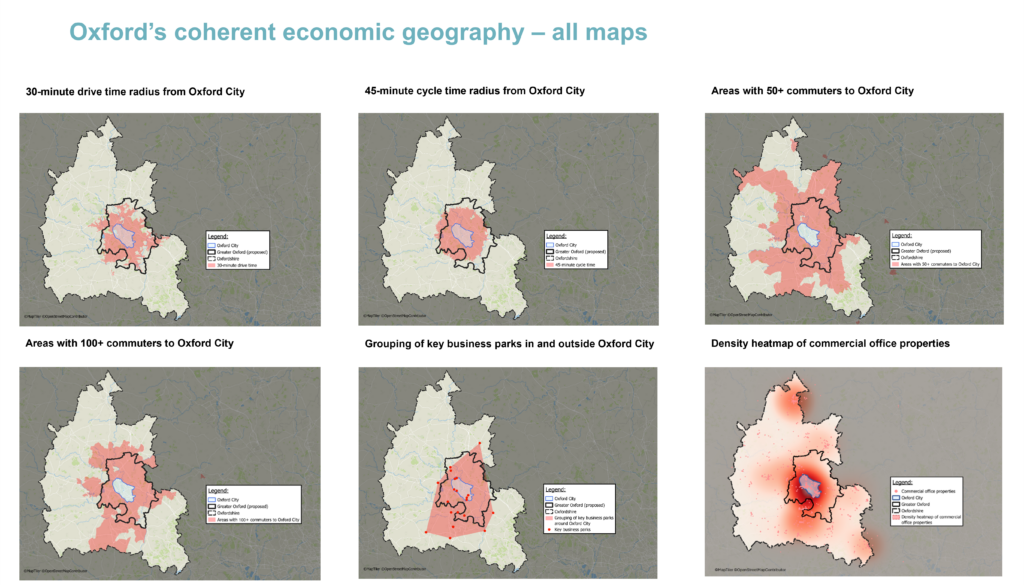
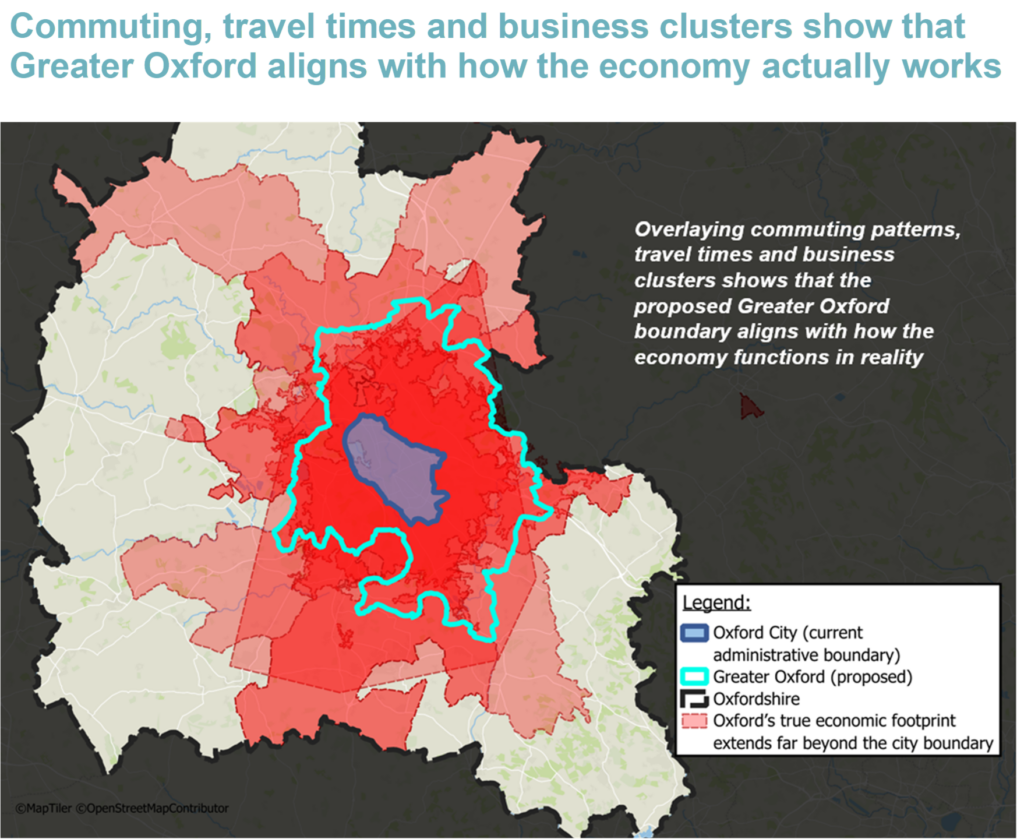
Source: Oxfordshire Local Government Reorganisation, Economic Growth Report (October 2025)
We then compared three governance scenarios side-by-side, with transparent bottom-up evidence for each — historic growth, site capacity, agglomeration theory and cluster dynamics — rather than a single point-in-time forecast. The “Greater Oxford” option delivered the strongest case.
Crucially, the evidence base was built with a capacity guardrail and an explicit monitor and manage clause: any uplift above the Standard Method is treated as contingent on site and infrastructure delivery, and a review is triggered if observed jobs growth sustainably out-turns the baseline. This is evidence that supports ambition without over-committing — and that can flex as delivery conditions change.
Our work demonstrates how vision-led, scenario-based evidence can make the case for transformational change at sub-regional scale, in a form that SDS teams will increasingly need.
Local Growth Plans: catch the “guiding star” and spatially express it
A key starting point for the SDS vision will be the Local Growth Plan (LGP) in those areas that are required by government to produce one [3]. LGPs should be “the guiding star” that provides strategic direction for other relevant plans and strategies and the wider work of Mayoral Strategic Authorities, their constituent Local Authorities, and local partners. In essence, the SDS should provide a spatial representation of the LGP, which will already have done some of the heavy lifting to establish an overarching consensus for economic growth and change, supported by proportionate evidence.
As of April 2026, most of those areas required to produce a LGP have published one, with the remainder nearing completion. Some other places (i.e. non-Mayoral Strategic Authorities, such as Devon and Torbay) are choosing to develop a LGP to seize the initiative to drive economic ambition.
A wide range of key growth sectors are identified across published LGPs – unsurprisingly weighted towards the eight growth-driving sectors set out in the national Industrial Strategy [4] – but also with others such as visitor/experience economy (East Midlands, Lancashire, London), agri-tech/agri-food (Cambridgeshire and Peterborough, York and North Yorkshire) and education (London) standing out as being locally significant.
Key growth corridors and clusters are identified, alongside the role each can play in delivering the LGP vision and objectives. Most also identify specific outcomes the Mayoral Strategic Authority wants to achieve for their area (such as inclusive growth, improved productivity) and the key infrastructure/investment priorities to achieve this.
So how do SDS take this forward, and translate overarching economic ambitions and priorities from a LGP into its spatial growth strategy (i.e. what, where and by when)? How can evidence be gathered to support this? We set out some thoughts below.
- Consider the various space and land requirements associated with key growth sectors identified in the LGP – in terms of overall scale of space but also type of premises required, and locational preference. This might deviate from current market provision and profile.
- Capture qualitative business intelligence from key local employers, sector groups and other interested parties – how can the SDS actively support their growth aspirations and overcome barriers to growth/investment?
- For key growth locations (corridors/clusters/opportunity zones etc.) identified by the LGP, establish the case for change through an area-specific logic model and develop infrastructure-led future scenarios to estimate the scale of development and size of cluster that could be brought forward.
Get in touch
Please get in touch with our team to find out more about how we can help and add value through our compelling insight, innovative methodologies and 25+ years of trusted socio-economic expertise.
[1] As indicated by the government’s recent consultation on proposed geographies over which spatial development strategies (SDS) should be produced.
[2] NPPF December 2025, PM1: Spatial development strategies.
[3] The English Devolution White Paper set out the government’s intention to introduce a statutory requirement for all Mayoral Strategic Authorities to produce a Local Growth Plan. This includes Mayoral Combined Authorities, Mayoral Combined County Authorities, and the Greater London Authority.
[4] Advanced Manufacturing, Clean Energy Industries, Creative Industries, Defence, Digital and Technologies, Financial Services, Life Sciences, and Professional and Business Services.